
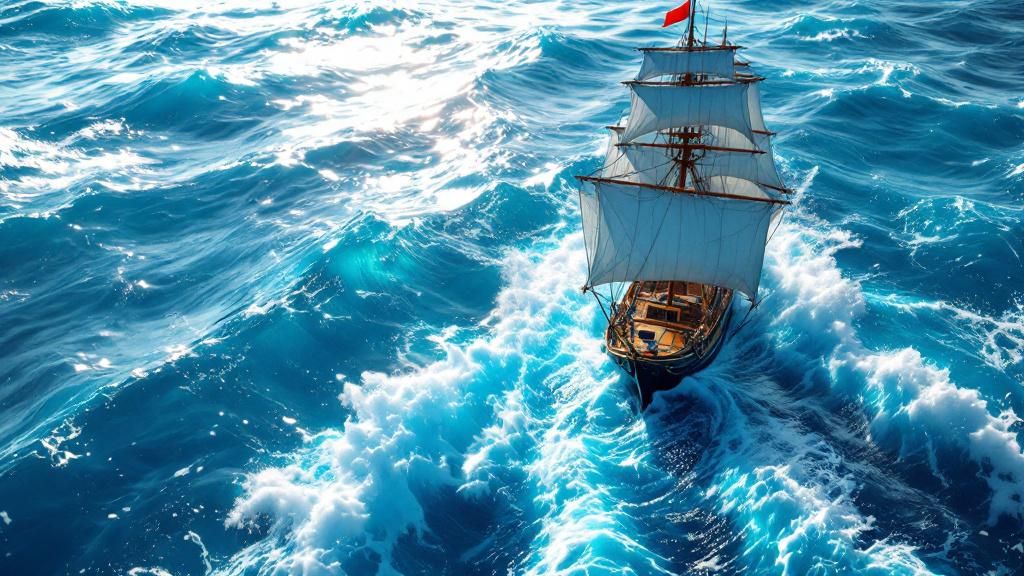
Studio Wildcard, the developer behind the wildly successful Ark: Survival Evolved franchise, is breathing new life into abandoned ideas from one of its most notorious failures. The studio’s 2018 pirate survival game Atlas, which received poor reviews and failed to bounce back, is being partially resurrected through Ark: Survival Ascended’s upcoming Tides of Fortune DLC. Rather than repeating Atlas’s mistakes, Studio Wildcard co-founders Jeremy Stieglitz and Jesse Rapczak have carefully selected the elements that genuinely succeeded—particularly the ship handling and water physics—whilst abandoning the punishing game design that made the original unplayable for most players. The new maritime DLC represents a calculated second chance at delivering the seafaring adventure that Atlas promised but failed to deliver.
Moving Past an Ambitious Failed Renewed Chance
When Atlas launched in Dec 2018, it arrived with considerable ambition but substantial technical issues. The open-world pirate survival game featured a networked ocean composed of stitched-together servers, enabling players to sail across enormous distances whilst fighting competitors and collecting resources. However, performance issues and stability issues plagued the launch, resulting in overwhelmingly negative reviews that the game failed to overcome. Unlike Ark: Survival Evolved, which bounced back from its own rocky start to become a cultural sensation, Atlas faded into obscurity despite its innovative concepts.
Jeremy Stieglitz acknowledged the game’s fundamental design flaws during his recent conversation with PC Gamer. The main problem wasn’t the technology or ideas themselves, but rather how they formed a game experience that felt unnecessarily punishing. Collecting materials required painstaking effort—logs could only be transported individually, ships had to be constructed plank by plank—and a solitary tactical error could wipe out dozens of hours of progress. “It’s a game that’s incredibly harsh, and if you make one mistaken choice you’ve just lost 50 hours of progress,” Stieglitz explained, though he stayed genuinely affectionate of certain mechanics.
- Atlas featured networked ocean servers permitting inter-server voyage experiences
- Resource collection was time-consuming and intentionally time-consuming
- Loss meant beginning anew from scratch with minimal recovery options
- Water mechanics and sailing mechanics were genuinely satisfying to participants
What Failed with Atlas
Atlas arrived in December 2018 with grand ambitions but struggled from the start upon launch. The pirate survival game set in an open world was built on cutting-edge systems—a interconnected ocean network made up of interconnected servers that permitted players to navigate freely between them whilst participating in sea battles and gathering supplies. Yet the ambitious technical foundation couldn’t overcome the real-world issues that plagued the launch. Frame rate and stability issues and technical instability produced a negative initial reception, and the overwhelmingly negative reviews that came after proved difficult to recover from. Unlike Ark, which ultimately overcame its own difficult start, Atlas was unable to restore player confidence.
The fundamental mismatch between Atlas’s technological ambition and its actual gameplay experience became more evident. Studio Wildcard had created something truly original from a technological perspective, but the design approach that wrapped around that technology created greater frustration than satisfaction. The developers had implemented systems that sounded compelling in theory but proved tiresome when actually playing. What should have been an thrilling pirate experience instead became a gruelling endurance test that demanded considerably greater patience and resilience for setbacks than most players could muster. The game is still available for purchase, but it never recovered the momentum needed to build a thriving community.
The Relentless Game Loop
At the core of Atlas’s issues lay an rigid design philosophy that made progress feel unpredictable and failures devastating. Resource gathering demonstrated this methodology—players could only carry logs one at a time when felling timber, transforming what should have been simple resource handling into tedious busywork. Building ships followed the same philosophy, requiring players to lay timber individually rather than using batch building techniques. Every system seemed built to maximise the time investment required whilst simultaneously raising the stakes of failure, creating a self-reinforcing cycle that penalised trying new approaches and creative strategy.
The repercussions of defeat in Atlas were notably severe, practically forcing players to restart from scratch with minimal opportunities for recuperation. A single navigational error, a poorly planned attack, or an unfortunate encounter with seasoned players could erase dozens of hours of amassed progress. This was not challenging gameplay—it was dispiriting structure that dissuaded people from attempting ventures or exploring new strategies. The combined result transformed what could have been an exciting survival experience into something that felt unnecessarily antagonistic towards player agency and enjoyment.
Currents of Luck: A Polished Approach
Rather than moving away from the pirate concept entirely, Studio Wildcard has decided to bring back the most compelling elements of Atlas whilst drawing lessons from its failures. The planned Tides of Fortune DLC for Ark: Survival Ascended represents a intentional effort to extract value from the unsuccessful experiment, concentrating on the aspects that truly connected with players. Stieglitz acknowledged that despite Atlas’s numerous problems, certain fundamental mechanics demonstrated undeniable appeal and potential. The sailing mechanics all exhibited technical achievement and creative vision that warranted a second chance in a more refined framework.
This time occasion, the developers are approaching ocean gameplay with hard-earned expertise about what truly creates survival games engaging without becoming exhausting. By integrating pirate ship building and sailing into Ark’s established framework, Studio Wildcard can capitalise on years of refinement and community feedback from their signature game. The DLC promises to deliver the satisfying physicality of ship construction and navigation without the punishing resource management systems that made Atlas so frustratingly tedious. This measured approach suggests developers who understand that good ideas sometimes require improved implementation rather than complete abandonment.
Advanced Ocean Physics and User-Friendly Mechanics
Ark’s water has historically been criticised within the player base as visually flat and lacking mechanical depth, acting chiefly as an obstacle rather than a compelling space. The implementation of networked ocean physics for Tides of Fortune substantially alters how water functions across the game world, building a responsive system that reacts authentically to user input. Rapczak emphasised that this engineering breakthrough transcends the expansion pack, providing creators and the wider development community fresh possibilities for environmental storytelling and mechanical advancement. The simulated physics system represents a significant upgrade to the engine’s environmental systems.
By concentrating on user-friendly mechanics instead of restrictive design, Tides of Fortune seeks to make pirate adventures attractive to a wider player base. The emphasis stays with the rewarding aspects of ship building and sailing—the physical feedback and tangible progression—whilst ostensibly removing the tedious resource gathering that burdened Atlas. This demonstrates a evolution of design philosophy, acknowledging that challenge and engagement don’t need to come at the cost of player enjoyment or accessibility. The DLC pledges to deliver adventure free from the frustration.
- Construct and personalise large-scale pirate vessels with adaptive building mechanics
- Traverse simulated ocean physics across interconnected water environments
- Explore new islands and find valuable loot through sailing adventures
- Participate in naval combat with other players and creatures
- Creation tools allow player-generated maritime content and gameplay
Transporting Dinosaurs to the High Seas
The incorporation of Ark’s iconic beasts into a ocean-based world creates an compelling design challenge for Studio Wildcard. Dinosaurs and prehistoric beasts have shaped the franchise since launch, and their presence in Tides of Fortune promises to differentiate this maritime expansion from conventional pirate games. Players will encounter these signature fauna not just on islands, but potentially within the ocean environment itself, creating unique encounters that merge the franchise’s essential nature with maritime exploration. This fusion of prehistoric fauna and ocean-based gameplay delivers a distinctive gameplay experience that differentiates Ark from alternative survival games exploring similar themes.
The combination of ship-based exploration with encounters with dinosaurs opens new strategic opportunities for both cooperative and competitive gameplay. Players must traverse dangerous seas whilst managing encounters with dangerous creatures, adding levels of depth to voyages across the ocean. This approach utilises Ark’s established creature systems and player experience with dinosaur survival systems, translating them into an aquatic context. By maintaining the franchise’s core appeal whilst venturing into new environmental territory, Tides of Fortune positions itself as both a natural evolution and a significant shift from conventional Ark mechanics.
