
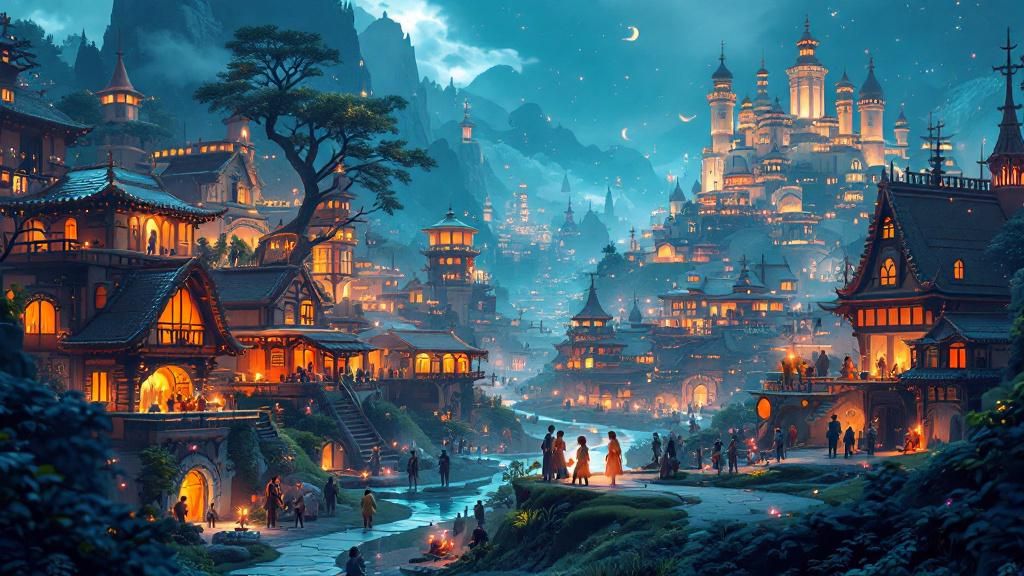
Two experienced developers from EVE Online have spent more than a decade crafting an ambitious new MMO through their studio Klang Games, where the innovative twist is that your characters continue indefinitely existing. Called Seed, the game unveiled a striking new trailer at GDC this week, featuring an original score by Icelandic artist Björk. Unlike conventional MMOs where characters remain static whilst you’re offline, Seed’s “Seedlings” continue to live in the persistent world around the clock, working, building, and evolving whether their players are logged in or not. The result is a richly immersive society-driven experience that draws inspiration from The Sims, Dwarf Fortress, and RimWorld, offering a level of character persistence and world-building complexity rarely seen in the genre.
The Purpose Behind Seed’s Living World
At the core of Seed lies a fundamental rethinking of what an MMO can be. Rather than treating the game world as a static backdrop that pauses when players disconnect, Klang Games has built a dynamic, evolving simulation where every character—every Seedling—continues their existence independently. This means your character might be tending their shop, producing materials, or contributing to society-level decisions whilst you’re away from your desk. The ambition is staggering: the developers have implemented everything from individual skeletal structures to intricate economic frameworks, creating a simulation so intricate that it rivals single-player titles like Dwarf Fortress and RimWorld in terms of mechanical depth.
The lasting nature of Seedlings fundamentally changes how players engage with the world. You’re not merely connecting to accomplish missions or grind for loot; you’re preserving an ongoing life within a community. This approach draws heavily from EVE Online’s legacy of player-driven experiences and community-created stories, where the actions of thousands generate real consequences and consequence. By permitting self-directed character action, Seed encourages players to think long-term about their roles within societies, whether as legislators, merchants, or humble craftspeople. The result is an MMO where substantial development happens even during your absence.
- Characters remain active and employed whilst players are offline
- Societies governed by regulations established by player leaders
- In-depth simulation covering taxes, resources, and infrastructure
- Players can join megalopolises or intimate hamlet communities
Communities as the Central Play Experience
From Bakery Conflicts to Electoral Upheaval
Societies form the vital centre of Seed’s gameplay loop, converting the MMO from a lone experience into a authentic community experience. Players within each society collaborate together to establish and sustain their society, whether they’re serving as elected lawmakers, managing commercial ventures, or gathering resources as regular members. The scale can fluctuate considerably—some societies might grow into vast futuristic cities with thousands of members, whilst others stay small settlements where a few close associates pursue shared crafting goals. This versatility ensures that every player, irrespective of preference for large-scale politics or intimate teamwork, finds their role within the world.
The team behind Klang Games have observed directly how societies generate the kind of emergent drama that made EVE Online legendary. From disputes over bread distribution to complete political upheavals, the community-managed administrative systems create genuine tension and repercussions. Laws passed by society administrators significantly affect how materials circulate, how buildings are constructed, and how individual Seedlings function within their communities. This degree of structural complexity means that every choice is significant, and every participant’s involvement—whether substantial or modest—shapes the trajectory of their community’s direction.
What makes this approach particularly compelling is that players needn’t choose between ambitious projects and intimate gameplay. Someone might oversee a large community with sophisticated economic mechanics and structural development, whilst simultaneously maintaining a modest individual crafting venture or helping with a companion’s settlement. The game’s design allows for this diversity, recognising that different players want distinct styles. A Twitch streamer could develop a prosperous urban centre with their community, whilst a team of multiplayer fans pursues independence in their corner of the world, and both experiences are similarly legitimate and satisfying.
- Community-chosen leaders enact laws regulating allocation of resources and construction
- Societies vary from expansive cities to small village communities
- Emergent drama and conflict arise naturally from rival objectives and administrative choices
Connecting Simulation Players and Caretaker Gamers
Seed’s appeal stretches past conventional multiplayer online players seeking competitive glory or social dominance. The game specifically targets simulation devotees—those fascinated with the detailed mechanics of titles like Dwarf Fortress and The Sims—who may have historically felt disconnected by multiplayer games’ focus on combat or lengthy grinding sessions. By embedding deep simulation systems into a persistent online world, Klang Games builds a platform where players can indulge their passion for mechanical depth whilst cooperating with fellow players. Whether managing individual character needs, refining resource systems, or creating elaborate settlement layouts, simulation enthusiasts find genuine opportunities for self-expression through Seed’s framework.
Equally significant is the game’s support for what might be described as “caretaker” gameplay—the philosophy that your Seedlings continue living and working whilst you’re offline. This eliminates the sense of penalty common to many MMOs, where absence equals lost opportunity or resource depletion. Instead, players can engage with Seed at their own pace, monitoring their characters’ progress and contributions without the worry about overlooking important events. This design philosophy particularly appeals to players with restricted gaming hours, parents balancing multiple commitments, or anyone seeking a more relaxed engagement model that respects real-world constraints.
| Player Type | Seed Experience |
|---|---|
| Simulation Enthusiasts | Deep engagement with character skeletal systems, resource management, and settlement design inspired by Dwarf Fortress and The Sims |
| Casual Community Builders | Running intimate hamlet societies with friends, pursuing shared crafting goals without pressure or competition |
| Content Creators | Establishing sprawling metropolises with Twitch communities, managing complex governance and infrastructure systems |
| Asynchronous Players | Offline character progression and contribution, eliminating pressure to maintain constant presence or miss opportunities |
The appeal of Seed’s design shows itself through its refusal to force players into a single playstyle. A simulation lover might spend hours refining their character’s living space and crafting workflow, whilst also being part of a broader community where their input counts to hundreds of other players. This range of legitimate experiences—from personal to expansive, from synchronous to asynchronous—demonstrates Klang Games has truly understood what different player types want from an MMO, rather than enforcing a uniform model.
Mobile Integration and AI Conversations
Klang Games has ambitious plans to extend Seed beyond the traditional desktop MMO experience through mobile connectivity. The studio envisions players monitoring their Seedlings’ progress during their commute, at work, or during other moments of downtime. This mobile-first approach aligns seamlessly with the game’s asynchronous design, allowing players to manage their characters and participate in society activities without demanding extended play sessions. The mobile companion app would theoretically enable players monitor resource gathering, respond to society matters, and even undertake light crafting tasks, keeping them connected to their virtual lives without requiring constant access at a computer.
Equally fascinating is Klang Games’ examination of generative AI for enriching player interactions within Seed’s societies. Rather than depending solely on player-to-player communication, the developers are testing AI-driven dialogue systems that could enable conversations between Seedlings and NPCs, or even between players and their own characters when offline. This technology could deepen immersion and storytelling possibilities, generating more dynamic social interactions within communities. However, the studio takes a careful approach about implementation, recognising the need to reconcile technological novelty with protecting the authenticity of player-driven narratives that make MMOs compelling.
The Potential and Challenges of Generative AI
The prospective benefits of AI integration in Seed are significant. Generative systems could stock the world with interactive NPCs, generate procedurally generated quests tailored to individual players, and facilitate more immersive storytelling within societies. AI dialogue systems might help less experienced players work through complex social structures or provide dynamic feedback on character development. For a game as simulation-intensive as Seed, AI could process numerous background calculations and interactions that would otherwise require enormous development resources, freeing the team to concentrate on player-oriented features and community tools.
Yet notable concerns persist regarding player authenticity. Excessive dependence on AI-generated content risks undermining the creative input from players that defines immersive multiplayer worlds. Players might experience their exchanges feel hollow if conversations are algorithmically generated rather than player-authored. Klang Games must carefully calibrate AI’s role—improving without displacing authentic human engagement—to ensure Seed continues to be a experience centred on groups of genuine individuals, not computer-generated engagement masquerading as genuine connection.
Project Advancement and Future Launch Plans
Klang Games’ decade-long development journey has yielded substantial progress towards realising Seed’s expansive vision. The studio’s recent appearance at GDC, complete with a visual presentation featuring an bespoke score by Björk, indicates the game’s evolution from initial idea to near-playable state. The developers have invested considerable time refining the intricate systems that enable Seedlings to persist in the world independently, whilst concurrently building out the social systems that control player engagement and progression. This extended development cycle reflects the intricacy of creating an MMO where each element in a character’s skeleton matters, and where economic mechanics must function alongside home decoration features.
Regarding launch timelines, Klang Games has remained notably careful about setting firm release dates, opting to guarantee systems are robust rather than hurrying to launch. The studio’s focus remains on stress-testing Seed’s fundamental systems with player communities and refining the balance between individual character progression and large-scale world simulation. With the GDC showcase demonstrating tangible progress and renewed momentum, speculation indicates the game may move into broader testing stages within the coming years. However, the developers’ dedication to excellence over rapid release suggests that Seed will arrive only when its ongoing world mechanics can genuinely provide on the promise of genuinely dynamic, evolving communities.
