
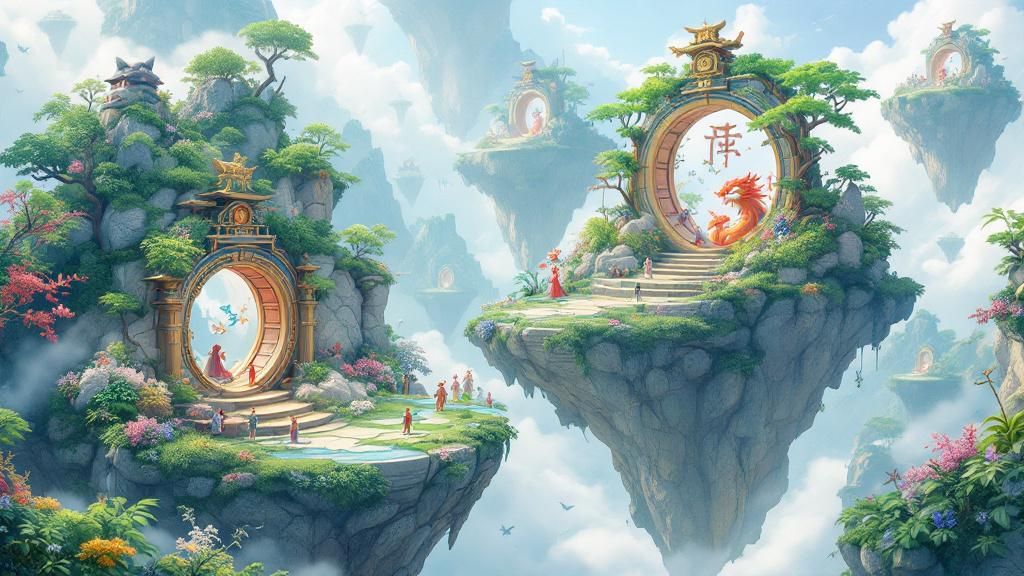
Enchanted Works’ upcoming physics puzzler Nomori wraps portal-based brain-teasers in the enchanting visual style of Studio Ghibli, creating what may be the most deceptively cosy puzzle game in years. Recently showcased at the ID@Xbox event at the Game Developers Conference, the game follows Kiko, a young girl who becomes lost in a spirit world inspired by Japanese folklore and the iconic films of Hayao Miyazaki. Whilst its floating islands, talking cats, and friendly mushrooms evoke the gentle charm of Spirited Away and Princess Mononoke, the underlying gameplay proves far more challenging—a deliberate design choice by Studio Director Marnix Licht and his distributed team at Enchanted Works to demonstrate that warm visual styles don’t necessarily mean straightforward gameplay.
A seemingly inviting Exterior Conceals Complex Puzzle Design
From the outset, Enchanted Works recognised an gap within the games market that many developers have overlooked: the desire for complex, sophisticated puzzle design wrapped in a soft, welcoming visual style. Licht explained that many cosy games adopt similarly relaxed puzzle design, but Nomori deliberately subverts this assumption. The parallel with Valve’s Portal is quickly evident as players advance past increasingly elaborate spatial challenges. What starts with basic movement across floating islands linked via fixed portals rapidly transforms into something considerably more demanding, demanding players think in three dimensions and reassess their understanding of gravity and orientation.
The ingenuity of Nomori‘s design resides in how it establishes its central gameplay rule: portals keep their spatial alignment, meaning the direction of gravity when entering stays the same upon exit. This seemingly simple rule generates profound spatial puzzles that recall the paradoxical spatial arrangements of M.C. Escher’s surrealist compositions. When users acquire the ability to rotate portals in quarter-turn intervals, the difficulty level intensifies sharply. Immediately, three-dimensional thinking turns critical—players have to conceptualise dimensions like a complex three-dimensional puzzle, trying and adjusting through approaches. It’s a masterclass in how design elegance and systemic richness need not be in conflict.
- Portals sustain orientation, shifting gravity direction upon exit
- Friendly Slimebun creature acts as movable base and puzzle key
- Temporal reversal systems allow scrubbing creatures through previous paths
- Portal rotation in 90-degree increments substantially enhances puzzle difficulty
Understanding the Principles of Portal Orientation
The portal mechanics in Nomori embody a radical break from conventional puzzle design, creating what Licht describes as “conservation of orientation” rather than momentum. This principle becomes the foundation whereupon increasingly sophisticated challenges are developed. As players move forward, they must internalize the relationship between portal alignment and gravitational direction, transforming theoretical spatial ideas into instinctive comprehension. The game’s genius resides in its gradual escalation—initial challenges allow players to grasp the basics through gradual trial-and-error, whilst later challenges demand precision and foresight. This carefully calibrated difficulty curve confirms that even players new to physics-based puzzlers can develop competency without becoming frustrated or patronised.
What sets apart Nomori from other portal-based games is its emphasis on 3D spatial problem-solving combined with environmental manipulation. Players aren’t simply navigating fixed pathways; they’re continuously reimagining their perception of spatial dimensions itself. The addition of rotating portal mechanics converts the puzzle landscape into something comparable to a Rubik’s Cube—a three-dimensional puzzle requiring mental rotation and structured experimentation. This mechanic pushes players away from straight-line logic and encourage creative trial-and-error, valuing inventive solutions and unconventional thinking. The pleasure obtained by solving these spatial conundrums stems not merely from reaching the next island, but from the intellectual journey of fundamentally reframing one’s understanding of the game world itself.
Gravitational Principles and Spatial Awareness
Understanding gravity’s significance in Nomori necessitates discarding conventional notions about physics. When Kiko steps through a vertically positioned portal, she appears through a horizontally aligned portal with gravity realigned as needed—what was once a cliff face turns into firm ground beneath her feet. This system, based on Escher’s impossible architecture, challenges players to visualise space from various viewpoints simultaneously. Opening levels establish this concept gradually, allowing players to test and watch how actions produce results. However, as complexity increases, players must anticipate gravitational shifts before performing them, planning complex sequences where orientation changes accumulate, creating intricate spatial puzzles.
The cognitive transformation essential for mastering these mechanics cannot be overstated. Players used to traditional platformers must unlearn ingrained assumptions about “up” and “down,” adopting in their place a relativistic framework where orientation is flexible and situational. This mental recalibration proves both challenging and deeply rewarding, as successful puzzle solutions create authentic feelings of achievement. The game’s graphical approach—with its Ghibli-inspired aesthetic and obvious directional cues—supports this learning process, ensuring that challenge originates in conceptual difficulty rather than visual confusion. By the time players meet sophisticated obstacles requiring portal rotation, they’ve built the intellectual agility required to manage increasingly elaborate spatial configurations.
- Gravity direction shifts based on portal orientation and exit point alignment
- Mental rotation skills become essential for solving complex geometric puzzles
- Escher-inspired geometry generates impossible-seeming but mathematically coherent spaces
The Slimebun Companion and Time Manipulation
Beyond gravity-bending portals, Nomori presents the Slimebun—a gelatinous, bunny-eared creature that remains crucial to progression. This friendly companion performs various purposes: it acts as a transportable base for movement, a means of opening doors between islands, and a puzzle mechanic in itself. Players manipulate the Slimebun telekinetically using Kiko’s Wind Grasp ability, placing it with care to connect spaces or create stepping stones across treacherous terrain. The creature’s soft appearance conceals its puzzle significance, embodying the game’s philosophy of combining intricate puzzles with an inviting, whimsical aesthetic that recalls Studio Ghibli’s most beloved works.
The genuine ingenuity emerges when players are able to reverse the Slimebun’s temporal progression, scrubbing it backwards and forwards along its earlier traversed path like rewinding a film. This mechanic, similar to Link’s Recall ability in The Legend of Zelda: Tears of the Kingdom, converts the Slimebun into a dynamic, time-aware platform. Players can position the creature at multiple points along its path, creating complex sequences where the Slimebun exists in different places at various times. This temporal manipulation layer adds profound depth to puzzle-solving, forcing players to consider not just space and orientation, but also cause and effect alongside timing.
Building Complexity Through Layered Systems
What distinguishes Nomori from competing puzzle titles is its sophisticated arrangement of mechanics. Each additional component—portal orientation, gravity shifts, the Slimebun, time manipulation—develops from previous knowledge without overwhelming players. Early puzzles focus on individual mechanics, allowing confident understanding before adding combinations. However, as difficulty increases, these systems interweave in increasingly complex ways. A single puzzle might demand rotating portals to shift gravity, positioning the Slimebun as a platform, and manipulating its temporal state simultaneously. This progressive difficulty ensures ease of entry for newcomers whilst delivering substantial challenge for veteran puzzle players.
The point portal rotation was unveiled during the demo proved illuminating—suddenly players must mentally navigate three-dimensional space like solving a Rubik’s Cube, envisioning how ninety-degree increments alter gravitational orientation. This cognitive leap transforms casual experimentation into purposeful puzzle-solving, where each action carries weight and purpose. The game rewards this mental flexibility with satisfying solutions and moments of true accomplishment. By structuring difficulty this way, Nomori accomplishes what many puzzle games aspire to: making players feel mentally stimulated whilst remaining thoroughly engaged with the charming world they’re exploring.
Rewarding Creative Solutions
What makes Nomori notably compelling is how it celebrates unconventional puzzle design approaches. Rather than funnelling players toward a single “correct” solution, the game invites players to experiment and values those who approach problems creatively. Studio Director Marnix Licht noted that puzzles are intentionally crafted to support multiple approaches to solving, allowing players to discover their own paths through each challenge. This design principle transforms what could feel like rigid constraint into genuine creative freedom. Players aren’t just following predetermined steps; they’re taking an active role in solving problems, trying different ideas, and experiencing authentic moments of realisation when their experimental approaches yield unexpected success.
The satisfaction gained from solving Nomori‘s puzzles arises primarily from this sense of agency and intellectual accomplishment. Each puzzle introduces a spatial puzzle that requires visualisation, strategic planning, and repeated experimentation. When players eventually solve a notably tricky setup—whether through rotating portals, placing the Slimebun, or controlling time—the payoff appears justified rather than artificial. This approach values player capability whilst keeping accessibility intact, creating an experience where both everyday players and puzzle lovers experience real fulfilment. The game places confidence in its audience to engage meaningfully with its systems rather than hand-holding them toward predetermined solutions.
| Puzzle Element | Core Mechanic |
|---|---|
| Portal Navigation | Conservation of orientation across dimensional gateways |
| Portal Rotation | Manipulating gravity direction through ninety-degree increments |
| Slimebun Positioning | Telekinetic platform placement and mobile key usage |
| Temporal Manipulation | Scrubbing Slimebun along previous paths for dynamic platforming |
The interaction between these mechanics creates puzzle scenarios where experimentation becomes the primary pathway to understanding. Players tend to move toward testing different configurations, observing how gravitational changes affect their approach, and discovering creative uses for the Slimebun that developers may not have directly foreseen. This dynamic play experience ensures that Nomori remains fresh and engaging throughout, as each puzzle presents new combinations and spatial demands that demand genuine cognitive engagement rather than rote memorisation of solutions.
